
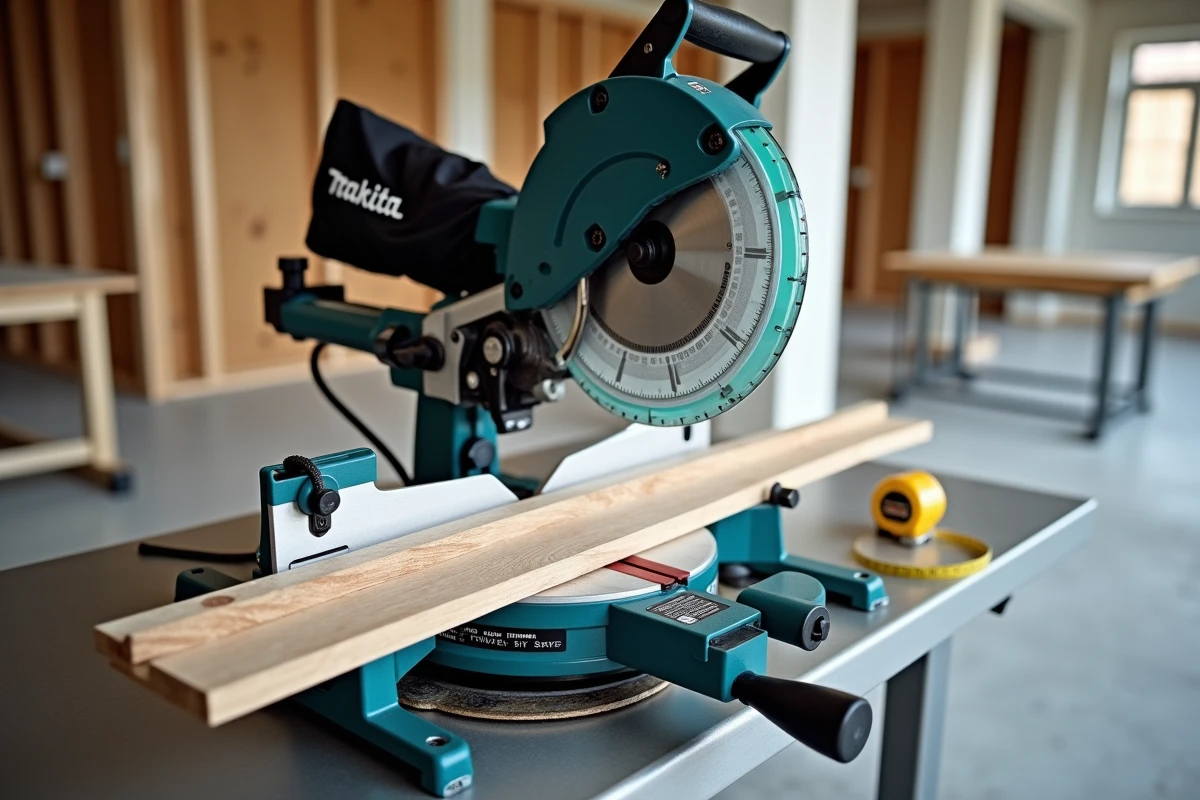
The Makita LS1018L is a miter saw equipped with a 260 mm blade and a 1430 W motor. It stands out with an integrated laser guiding system, powered by mains electricity, which projects a cutting line directly onto the workpiece. This laser, adjustable via calibration screws, allows for repeatable blade positioning, even after multiple relocations of the machine.
Laser Guidance of the Makita LS1018L: Calibration and Long-Term Reliability
The mains-powered laser line is one of the features that sets this machine apart from entry-level miter saws. Unlike battery-powered lasers, the one on the LS1018L does not experience a gradual decrease in intensity. The line remains visible on light wood as well as on melamine panels.
Calibration is done using screws that are accessible without disassembly. According to feedback from professional users published between 2022 and 2024 on the UK Workshop and LumberJocks forums, the laser line remains stable even after multiple transports, with very little drift observed over time on well-maintained machines.
For those who want to learn more about the Makita LS1018L, the Makita Canada documentation (reference LS1018/LS1018L) details the recalibration procedure, which can be completed in a few minutes with a simple screwdriver.
This stability of the laser has a direct consequence: for identical miter cuts (baseboards, moldings, frames), the visual marking remains consistent from one piece to another. The time savings are especially noticeable when making dozens of cuts without needing to recheck the alignment.
Cuts on High-Density MDF and Laminate: Actual Blade Performance
Standard product sheets rarely mention the performance of a miter saw on modern composite materials. High-density MDF and laminate, commonly used in interior fittings, present a specific problem: chipping at the cut exit.
Testimonials from carpenter artisans on the Metabricoleur forum and on French-speaking Facebook woodworking groups (between 2021 and 2024) indicate that the LS1018L produces less chipping at the exit than competing models of equivalent range. However, this cutting cleanliness depends on the choice of blade.
Recommended Blades for Composite Materials
Makita recommends blades with 60 to 80 teeth for this type of work. The logic is simple: the more teeth there are, the smaller the gap between each tooth, and the less time the material has to lift and break at the exit.
- 60-tooth blade: versatile compromise, suitable for standard MDF and pine or softwood moldings, with good cutting throughput
- 80-tooth blade: superior finish on laminate and high-density MDF, but slower feed rate and slightly increased effort on the motor
- Standard blade supplied with the machine: acceptable for common solid wood, but should be replaced as soon as finish quality on composite panels becomes a priority
The choice of blade transforms the result. On a lacquered MDF baseboard, the difference between the original blade and an 80-tooth blade is visible to the naked eye, without even running a hand along the edge.
Cutting Capacity at 90° and 45°: What the Measurements Really Mean
The cutting capacity at 90° of the LS1018L is 91 x 310 mm (height x width). At a 45° miter cut, this capacity drops to 91 x 220 mm. These values, derived from Makita specifications, define the maximum section of the piece that the blade can pass through in a single pass.
In practice, a cutting height of 91 mm covers almost all baseboards, moldings, and paneling available in stores. The width of 310 mm at 90° allows for cutting standard-sized solid wood boards without repositioning the piece.
Comparison with the Makita LS1016FLB
A discussion thread on the Système D forum compares the LS1018L with the LS1016FLB. The cutting capacities are similar (91 x 310 mm at 90° for both), but the LS1016FLB offers a slightly higher capacity in combined 45°/45° cuts. The price difference between the two models was about 300 euros at the time of the discussion.
For common precision work (baseboards, frames, cladding), the difference in combined cutting capacity only has a real impact on pieces with atypical sections. The LS1018L meets the needs of the majority of interior fitting projects.

Makita LS1018L vs. Festool Kapex: Two Philosophies of Precise Cutting
The comparison often arises on French-speaking forums. The Festool Kapex is positioned in a significantly higher price segment, featuring an integrated dust extraction system and micrometric angle adjustment.
The LS1018L takes a different approach. The laser guidance replaces the shadow marking used by Festool. Both systems achieve comparable precision on standard miter cuts, but the method differs: the laser projects an active line onto the piece, while the shadow marking uses ambient light to create a passive reference line.
Users on Metabricoleur report mixed feedback on some Kapex models, particularly regarding long-term reliability. The LS1018L benefits from a simpler mechanism, with fewer electronic components that could fail.
- Budget: the LS1018L is in a significantly lower price range than the Kapex, making it a relevant choice for artisans seeking precision without investing in the absolute high-end
- Mechanical robustness: the simplicity of the LS1018L’s radial mechanism reduces potential failure points
- Dust extraction: the Kapex integrates a more efficient dust extraction system, a real advantage in a closed workshop
The choice between the two machines depends on the context of use. For repetitive miter cuts on-site, with frequent transport, the LS1018L offers a reliability-to-price ratio that justifies its popularity among carpenters and fitters.
The Makita LS1018L is not a universal machine. It excels in a specific niche: miter and bevel cuts on medium-section pieces, in solid wood or composite panels, with a level of finish that the laser and the right blade choice make reproducible from one cut to another.