Interlocking pavers in a driveway or patio always end up turning green. Moss, grasses, dandelions: the joints provide an ideal space for seeds to germinate. The problem does not come from the pavers themselves, but from what happens between them, in those few millimeters of sand exposed to the elements. Weeding the surface does not solve anything if the joint remains open and the substrate intact.
The sand joint, the true culprit behind the return of weeds
Have you ever noticed that weeds always reappear in the same spots? This is because the jointing sand compacts and erodes over time. Rain, frost, and repeated foot traffic create cavities between the pavers.
These cavities accumulate organic matter: decomposed leaves, dust, plant debris. In just a few months, a real compost forms in the gaps. Seeds carried by the wind or birds have only to settle there.
As long as this cycle is not interrupted, no weeding lasts more than a few weeks. The most common mistake is to pull out the visible part without treating the joint. The roots remain, the substrate stays, and regrowth is guaranteed.
To truly weed interlocking pavers deeply, it is necessary to combine the removal of plants with the restoration of the joint. Specifically, this means emptying the eroded joint, removing the accumulated organic layer, and then refilling with a stable material.
Thermal or mechanical weeding: choose according to the surface
There are two main families of methods that comply with regulations and preserve the pavers. The choice mainly depends on the size of the area to be treated.
Mechanical scraping for small areas
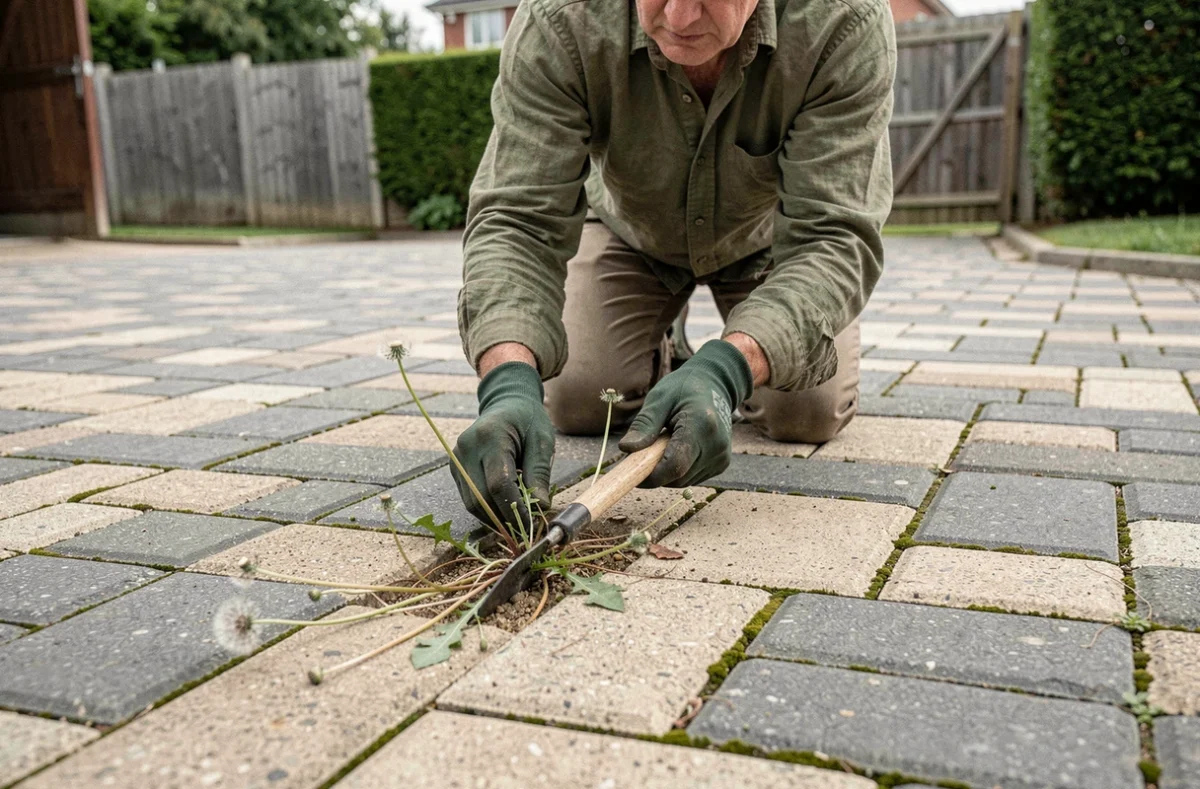
A weeding knife or joint scraper allows you to extract the roots and organic deposits stuck between the pavers. It is slow, but it is the method that cleans the most thoroughly.
- Run the blade along each joint, scraping down to the sand bed.
- Sweep up the residues, then vacuum or rinse to remove any remaining seeds.
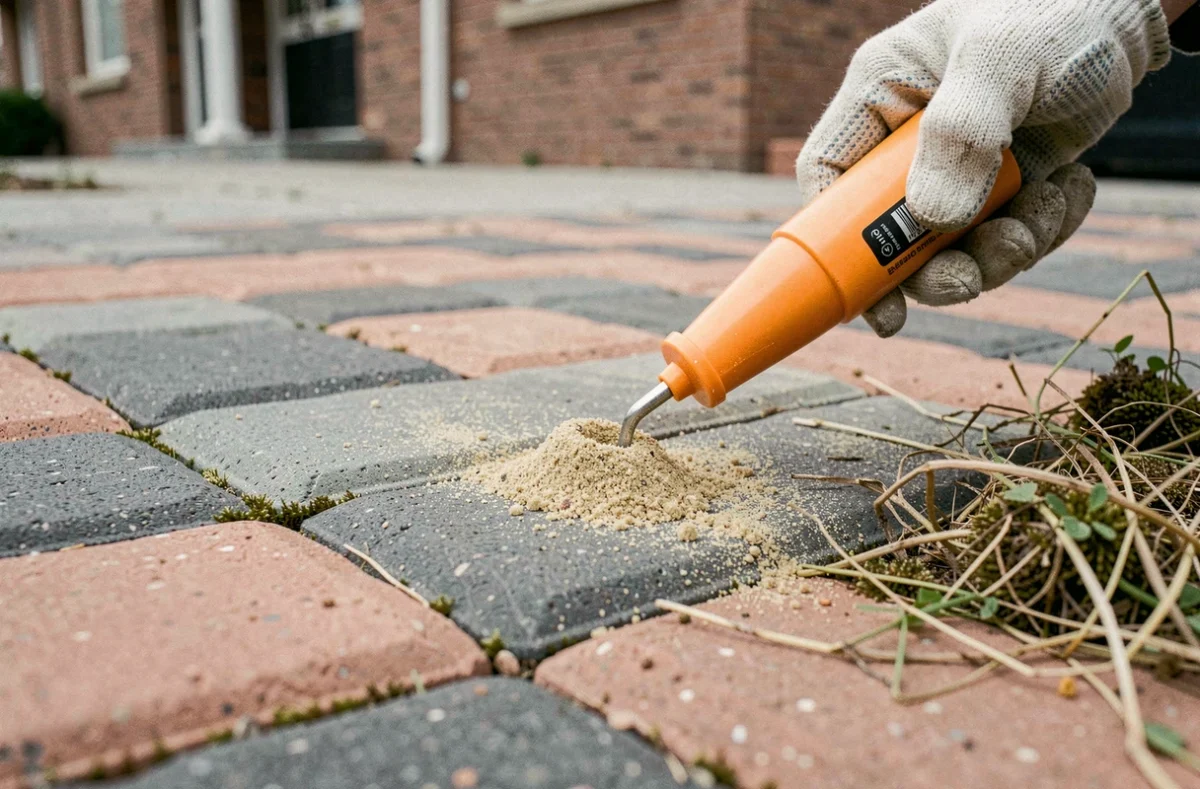
- Refill immediately with polymer sand or stabilized jointing sand.
On a modest-sized terrace, the result is clear in half a day. Polymer sand hardens upon contact with water and prevents seeds from taking root for several seasons.
Thermal weeding for large driveways
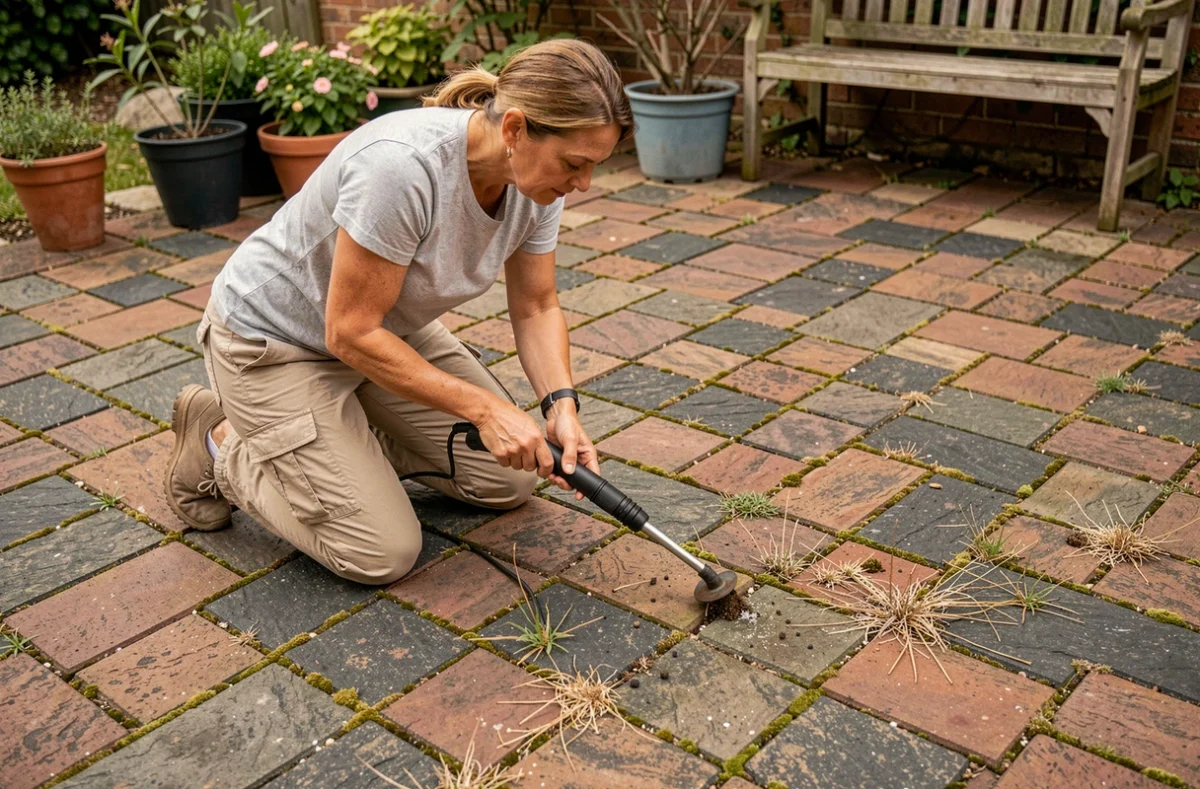
Thermal weeders (gas or hot water) destroy plant cells through temperature shock. Hot water penetrates the joint and reaches the roots, making it more effective at depth than a simple surface flame.
The direct flame mainly acts on the aerial part of the plant. Therefore, several passes at intervals of a few weeks are necessary to exhaust the root reserves. In contrast, boiling water may suffice in one or two treatments on young weeds.
Vinegar, salt, baking soda: what the regulations really prohibit
Many guides recommend white vinegar as a natural herbicide. The problem is legal before it is technical. Acetic acid has no marketing authorization as a herbicide in France. Applying it to your pavers is akin to using an unapproved plant protection product.
Since July 1, 2022, a decree prohibits the use of plant protection products in private properties for residential use, including outdoor spaces like driveways and patios. Only three categories remain authorized: biocontrol products listed by the administration, low-risk products, and those permitted in organic farming.
Table salt poses another problem. It does not degrade and contaminates the soil deeply. After several applications, salt renders the soil sterile well beyond the targeted joints. If your pavers border a lawn or a flowerbed, the damage to nearby vegetation can be irreversible.
Baking soda has a limited effect on moss but does not act on the roots of established plants. It can complement mechanical cleaning, but not replace it.
Joint maintenance after weeding: the key to a lasting result
Weeding without restoring the joint leaves the door open for the next colonization. Refilling is the step that most homeowners neglect, and it is precisely what makes the difference between a result lasting three weeks and one lasting several years.
There are two main options for filling:
- Polymer sand, which hardens after wetting and blocks germination. It withstands moderate rains well but can crack after repeated freeze-thaw cycles.
- Classic jointing sand stabilized with cement, which is stiffer and suitable for high-traffic areas like garage entrances.
- Flexible epoxy resin joints, which are more expensive, offer near-total sealing and eliminate the germination substrate.
Regardless of the chosen material, the joint must be flush with the surface of the paver. A joint recessed by a few millimeters is enough to accumulate organic matter and restart the cycle.
Regular sweeping (once or twice a month in spring and autumn) prevents leaf deposits from turning into compost. It is a simple gesture that significantly reduces the frequency of weeding.
A well-filled joint and a regularly swept surface reduce the number of annual interventions by several. Deep weeding only makes sense if accompanied by this preventive maintenance. Without it, even the most radical method only protects for a time.