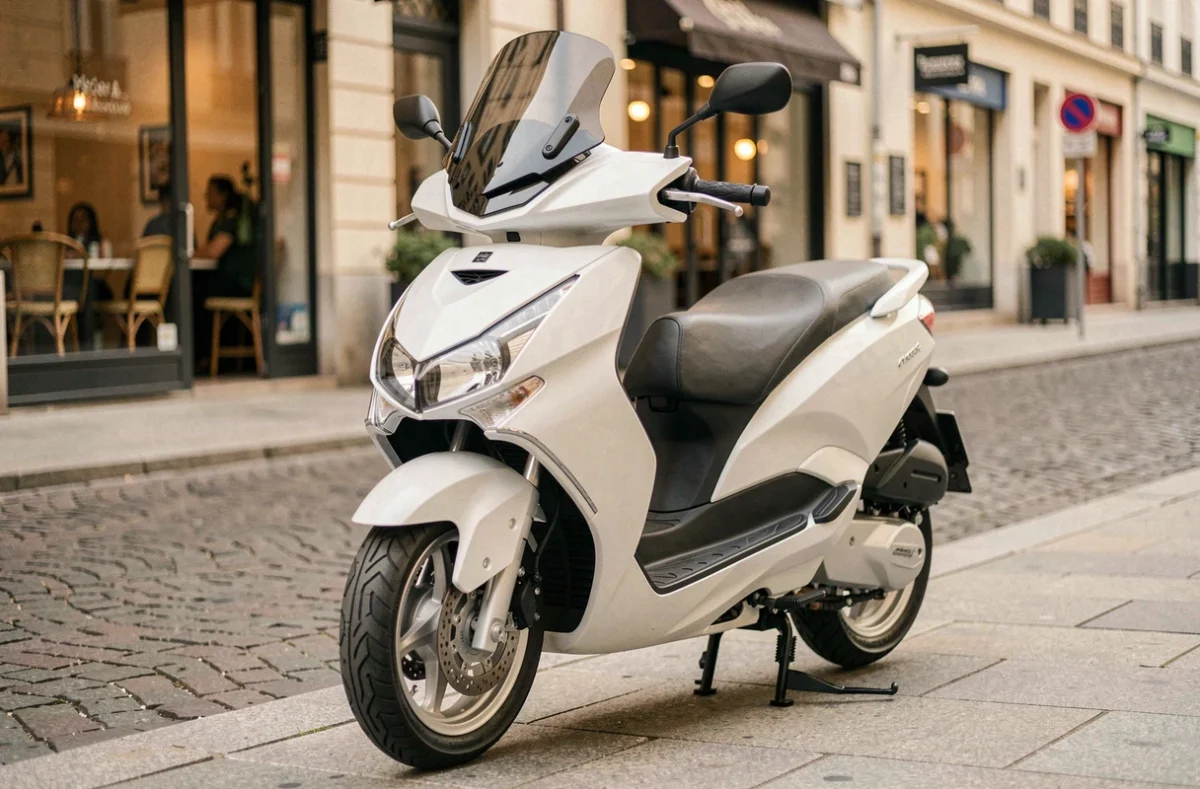
A 50 cc scooter restricted to 45 km/h and capped at 4 kW of motor power remains an L1e-category moped, regardless of the manufacturer’s marketing. Differences between models come down to low-end torque, kerb weight and transmission technology—not some hypothetical extra horsepower.
Registered electric mopeds fall under the same L-category rules and are not exempt from roadworthiness testing just because they are electric: vehicles first registered in 2020 or 2021 are due for their first test in 2026, followed by a test every three years.
Motor torque and kerb weight: the real performance indicators for a 50 cc scooter
On a moped limited to 45 km/h, top speed is the same from one model to another. What changes the riding experience is the torque available from the very first revs. An electric motor delivers maximum torque from a standstill, providing brisk acceleration off the line, whereas a Euro 5+ fuel-injected 50 cc combustion engine needs to build up revs.
Weight has a direct impact. An 87 kg scooter (like some compact urban models with 10-inch wheels) responds more quickly than a 130 kg three-wheeler, even if both have the same power limit. The better the torque-to-weight ratio, the nimbler the scooter feels in town.
For electric models, we find that the three-wheel configuration offers welcome stability when cornering and in wet weather. However, a powerful licence-free 3-wheel scooter is still heavier and takes up more space when parking—a trade-off to consider based on your daily needs.
Removable battery and theft insurance: the factor product listings overlook
The race for maximum range can obscure a practical issue. On an electric 50 cc equivalent, the battery accounts for a significant share of the vehicle’s total cost. According to an insurance guide published on November 10, 2026, battery theft cover depends on the policy and may be excluded when the battery is removable or rented separately.
Before comparing models by their technical specifications, ask your insurer a specific question: is the battery covered if it is stolen separately from the scooter? A model with a battery that can be easily removed for home charging is, paradoxically, more vulnerable to battery theft.
Charging and winter storage: factors that affect your choice of model
A Vmoto dealer recommends bringing removable batteries indoors in cold weather and, for long-term storage, keeping them at between 50 and 70% charge. This means that someone living in an apartment without a lift, with a battery weighing several kilograms, may find it impractical to charge at home.
- Check the weight of the battery on its own and whether it has handles or transport wheels before buying
- Ask your insurer for an explicit clause covering theft of the battery when detached from the vehicle
- Plan for a temperature-controlled storage space for winter, as cold reduces the capacity of lithium-ion cells
The model with the longest advertised range is not the best choice if you cannot recharge its battery every day.
Electric 50 cc equivalent scooter: actual costs and local incentives
Prices for electric 50 cc equivalent models start at around €2,700 for connected entry-level models with removable batteries, and exceed €3,200 for models with a WMTC range of over 100 km. Insurance, maintenance (lower than for combustion models, but not zero) and charging costs must also be factored in.
Do not assume that a national purchase subsidy will be available when budgeting. Incentive schemes change, and some vehicles may no longer qualify depending on the environmental score in force. Local subsidies (from metropolitan authorities or regions) may still be available, however, so check with your local authority before signing the order form.
Euro 5+ combustion or electric: running costs make the difference
A Euro 5+ fuel-injected 50 cc combustion scooter is still cheaper to buy. Routine maintenance (oil changes, spark plugs, drive belts) adds an annual cost that electric models almost entirely eliminate. For a few kilometres of daily urban riding, home charging costs just a few dozen cents per full charge.
The upfront price difference is recouped after two to three years of intensive use. For occasional or seasonal use, combustion models retain a clear cost advantage.
Moped roadworthiness testing: a deadline to plan for when buying
Since roadworthiness testing for motorised two-wheelers came into force, L-category mopeds have not been exempt. Models registered in 2020 or 2021 must undergo their first test in 2026, and every three years thereafter. This applies to both combustion and electric models.
Buying a used scooter without a valid roadworthiness test can lead to unexpected costs if any issues are found (lighting, brakes or noise levels on combustion models). Checking the date of the last test is one of the things to do before any purchase.
- Check that the registration certificate is valid and confirm the date of the next roadworthiness test
- For a used electric scooter, request a battery diagnostic (number of charge cycles, remaining capacity)
- Make sure the model has not been derestricted, as this invalidates its L1e compliance and insurance
The licence-free scooter market grows more diverse every year, with compact Euro 5+ combustion models alongside connected electric scooters with removable batteries. Choosing the right model depends less on its stated power than on how practical it is in everyday use: battery weight, insurance cover, ease of charging and long-term maintenance costs. A real-world test ride and a careful read of the insurance policy are worth more than comparing spec sheets.