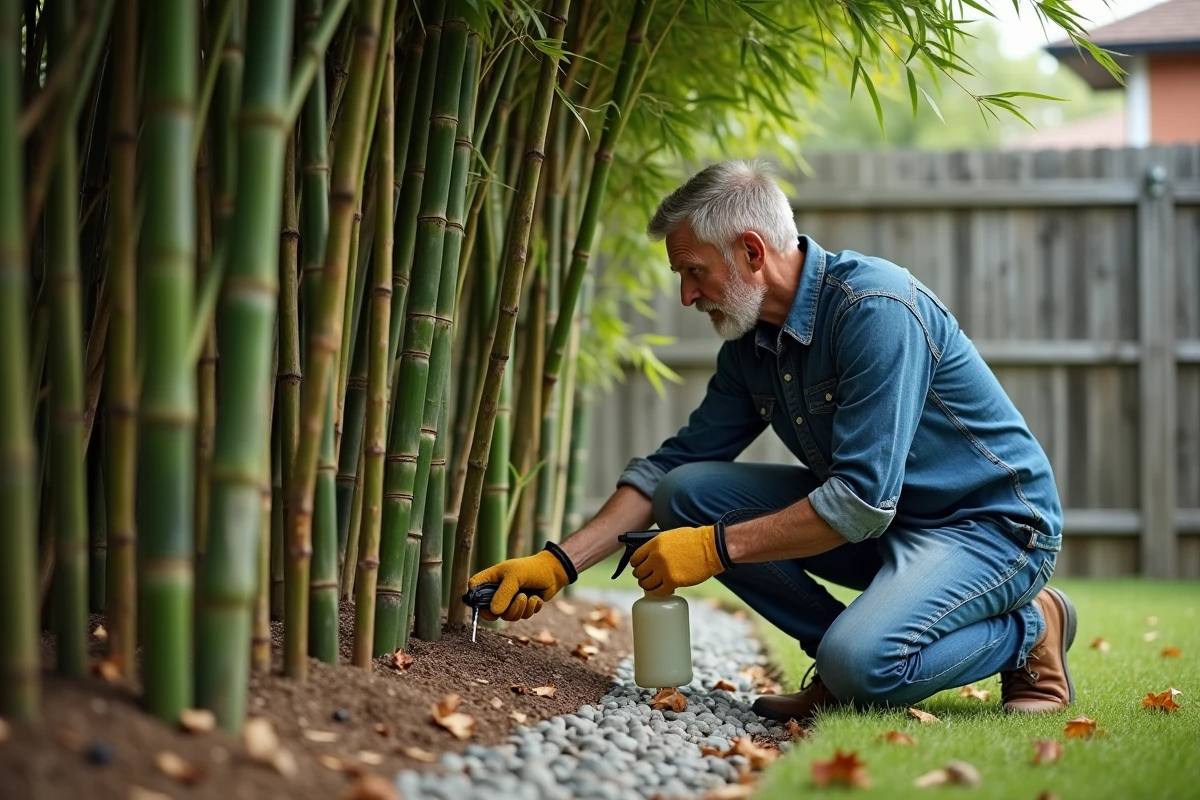
Bleach applied to cut culms or poured at the base of a running bamboo clump does not destroy the rhizomes. Sodium hypochlorite acts on the superficial tissues, oxidizing the exposed cellulose, but does not migrate into the underground network of a Phyllostachys capable of extending several meters per year. We systematically observe regrowth in the weeks that follow, sometimes more vigorous, as the plant mobilizes its root reserves in response to stress.
Bleach on bamboo: what chemistry allows and what it prohibits
Sodium hypochlorite decomposes rapidly upon contact with the organic matter in the soil. Its half-life in a humic substrate is a few hours. In practical terms, the product loses its oxidizing power before reaching the rhizomes located several tens of centimeters deep.
The concentration of household bleach (around 2.6% active chlorine) is largely insufficient to necrotize lignified tissue. Even a more concentrated solution applied directly into a hollow culm does not diffuse to the nodes of the rhizome, as bamboo compartments its vessels. The rhizome remains intact and functional despite the treatment.
We recommend understanding this limitation before considering any intervention: it is theoretically possible to kill bamboo with bleach, but the field contradicts this approach in almost all cases documented by gardening communities.
The only observable effect remains a browning of the cut culms and a temporary slowdown in growth at the application point. This cosmetic result disappears within a few weeks.
Soil pollution and regulatory responsibility: the concrete risks of bleach in the garden
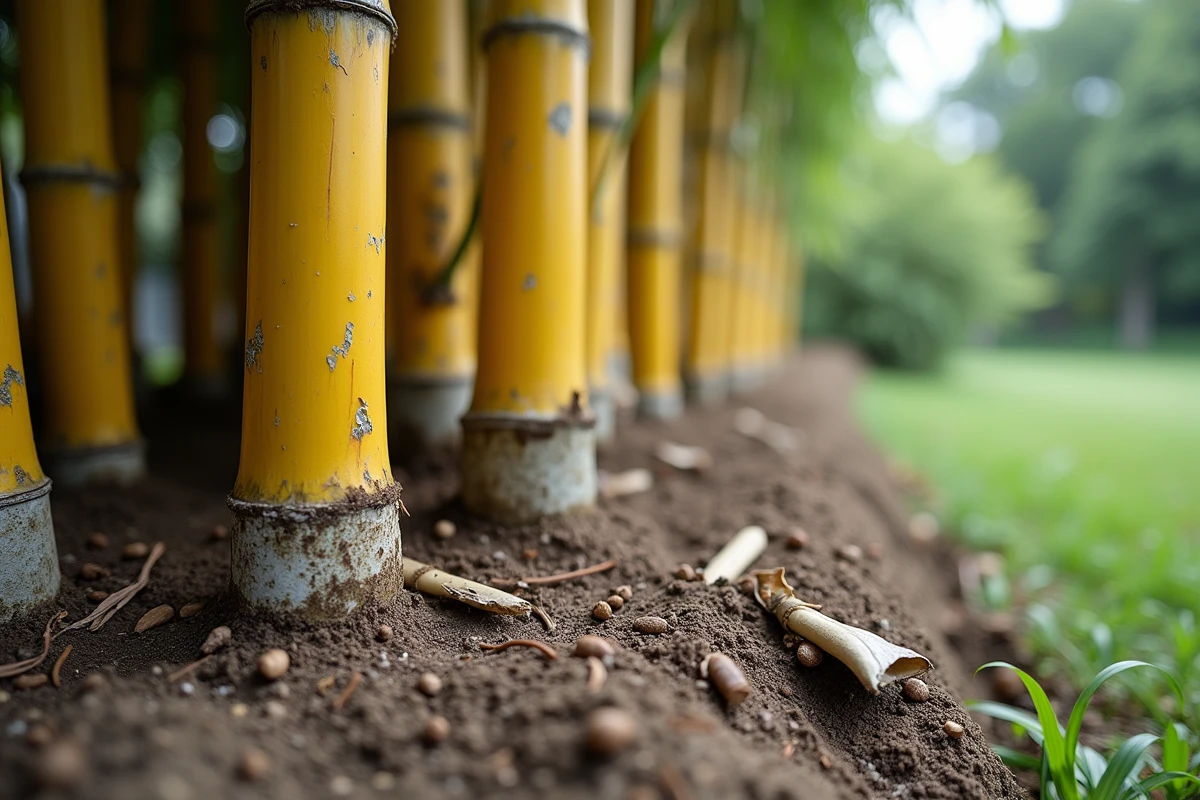
Bleach is more harmful to the soil than to bamboo. The chlorine released destroys the microfauna (nitrifying bacteria, mycorrhizae, earthworms) in a much wider radius than the treated area. A soil whose biology is altered loses its ability to nourish neighboring plants and to drain water properly.
The risk of runoff into surface waters is real, especially on sloped terrain or saturated clay soil. Chlorinated residues in a ditch or nearby watercourse constitute a characterized pollution.
Regulatory framework on the misuse of biocides
Using bleach as a herbicide constitutes a diversion from the intended use of the product. Several advisory bodies (gardening associations, local authorities) explicitly discourage this practice. In the event of observed pollution, the user’s liability may be engaged, a trend reinforced by European regulations on biocides and national restrictions on plant protection products.
This point is rarely mentioned in mainstream articles, but it carries significant weight: a neighbor who notices degradation of their hedge or contamination of their well can take action against the person who applied it.
Mechanical protocol for eliminating running bamboo without chemicals
The only reliable method relies on exhausting the rhizome’s reserves by systematically suppressing photosynthesis. The principle is simple, but execution requires consistency over several seasons.
- Cut all culms to the ground, without exception. A single forgotten culm is enough to feed the underground network. Use a saw or lopper depending on the diameter.
- Remove each shoot as soon as it appears, before it exceeds ten centimeters. This monitoring should be weekly in spring and early summer, the period of active growth.
- Maintain this cutting regime for two to three years. The rhizome, deprived of energy input, eventually exhausts and dies.
- On a large area, using an opaque tarp (woven geotextile or EPDM tarp) placed after the initial cut accelerates the process by completely blocking light.
A fragment of rhizome containing three nodes is enough to regenerate a complete clump. During uprooting, each piece left in the ground is a potential regrowth. We recommend sifting the soil on small areas or using a mini-excavator to extract as many rhizomes as possible on larger plots.

Anti-rhizome barrier: prevent rather than treat
Installing an anti-rhizome barrier remains the only sustainable preventive solution to contain running bamboo. The principle is to bury a rigid membrane made of polypropylene or HDPE around the entire perimeter of the planting area.
The installation depth must be sufficient to intercept the rhizomes, which primarily progress in the upper horizons of the soil. The barrier must extend a few centimeters above the soil level to prevent rhizomes from passing over it.
The joints between sections are the weak point of the system. Insufficient overlap or faulty bonding allows a rhizome to pass through in a few months. We regularly observe escapes in installations where the joints have not been welded or secured with clamping rails.
Maintenance of the barrier
An annual inspection of the perimeter allows for the detection of rhizomes attempting to bypass the obstacle from above. These attempts to cross are identified by the appearance of shoots along the barrier. Cutting them immediately prevents any external colonization.
Bleach has no role to play in this system. Mechanical prevention and seasonal vigilance remain the two pillars of effective management of running bamboo in a garden. It is better to invest time in the proper installation of a barrier and in the regular cutting of shoots than to rely on a chemical product whose effect on rhizomes is null and its impact on the environment very real.